

 Medically reviewed by
 The loss of hair is emotionally draining, particularly when bald spots start showing up on one without any prior notice. A procedure referred to as steroid injections or intralesional corticosteroid injections is one of the best medical remedies to patchy hair loss, most especially Alopecia Areata. Dermatologists tend to treat it as a primary treatment due to its high success rate, rapid onset, and that of hair in smooth bald areas.
What is Alopecia Areata?
Alopecia Areata is an autoimmune disease where the immune system wrongly assaults the hair follicles, resulting in round, smooth areas of hair loss on the scalp, eyebrows, beard or body. The condition may present itself abruptly, and it tends to be unforeseeable. Early treatment is effective in most instances and remains in the stimulation of hair growth and to avoid any further increase of bald patches.
What are Steroid Shots to Treat Alopecia?
In-Clinic Dermatological Therapy
Steroid injections are a medical technique used in the treatment of alopecia involving the injection of Triamcinolone Acetonide, most commonly, into the bald patches of the scalp. Such injections are referred to as intralesional corticosteroids since the drug is injected into the skin where inflammation has occurred. In doing this, the treatment has a direct consequence of calming down the immune response, causing inflammation to the follicles and hair to grow. The use of steroid injections is favoured over oral steroids since it is localised and does not exhibit general side effects on the whole body. They work effectively, particularly on small to medium bald patches of the scalp, beard and eyebrows.
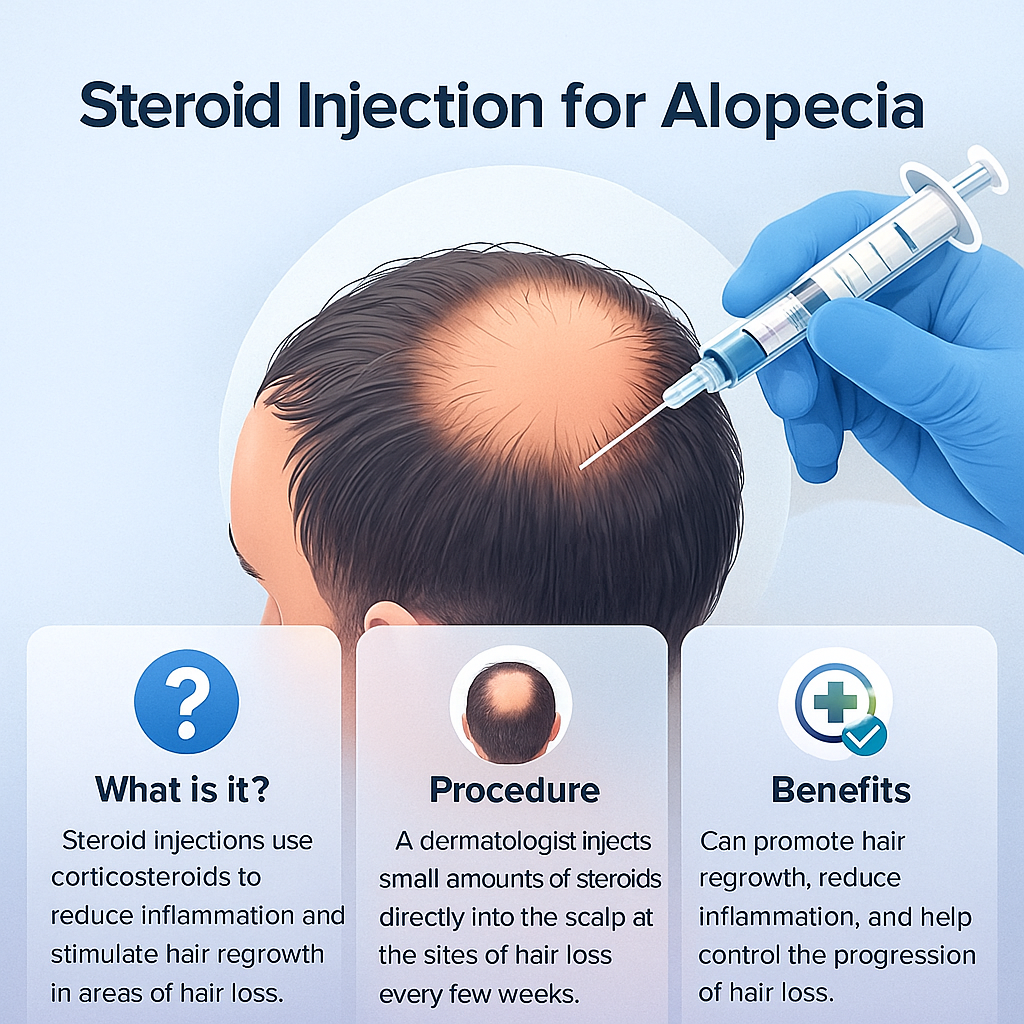
The Effect of Hair Regrowth in Steroid Injections
The mechanism of action of steroid injections is to suppress the autoimmune attack, which leads to alopecia areata. Once the immune cells attack the follicles, the follicles enter a resting period, leading to immediate loss of hair and smooth bald patches. Corticosteroids also suppress this inflammation and give the immune system the message not to attack the follicles.
After the inflammation subsides, the follicle has a chance to resume the growth phase with the results of fine, soft vellus-like hairs. With time, these hairs are thicker and darker, and they eventually mix with the rest of the hair. This therapy is effective in patients experiencing a recent onset of loss of hair in the scalp, patchy in size, and periodic instances of alopecia.
Investigators
What to Expect When Steroid Injections are Being Given to the Patient?
The steroid injections are easy and most of the time last between ten and twenty minutes. In the appointment, the dermatologist will look at the bald spots first and decide on the quantity of medication required. Small volumes of dilute Triamcinolone Acetonide are then injected into the affected parts with the help of a fine needle. The spacing of the injections is about one centimetre in order to have the medicine spread uniformly over the patch.
The feeling of pain may be characterised by the patients as a slight pinch or a slight burning sensation, yet the pain is not that severe and can be tolerated. Other clinics use a numbing cream prior to the procedure, particularly with the eyebrows or beard. Patients also do not have to spend any time off since they are free to resume their normal schedule after the session.
How Many Sessions are Needed?
The majority of patients need multiple rounds of steroid injections that will produce tangible outcomes. The conventional treatment course implies a session every four to six weeks. The optimal and standard regrowth takes three to six sessions, depending on the size and duration of bald patches. Others start having some indication of hair growth after the first or second session, and others can take several months of regular therapy. Dermatologists tend to re-process the course of progress after three sessions to determine whether the therapy is successful and to proceed with it, modify dosage, or consider other therapies.
When Will Hair Grow Back?
Hair regrowth takes time and depends on the individual, although most patients experience the first signs of improvement after several weeks. Typically, the initial sign of growth of fine soft hairs comes between two and four weeks following the initial injection. These vellus hairs continue to thicken and become pigmented after some weeks. High hair growth is most generally observed after three to six months of regular injections. Those with smaller and newer patches usually react quicker than those with old bald spots. One should be patient because the hair grows at a very slow rate, and may vary between individuals.
Steroid Injections Effective vs Ineffective
One of the most effective treatments for Alopecia Areata is believed to be the steroid injections, but they work best when the area of the scalp affected is less than half of the scalp. Various dermatological studies demonstrate that 60-80 percent of patients have significant regeneration of skin after attending a couple of sessions.
Recently, small patches have had a higher success rate, and the long-standing or recurring cases have slightly lower success rate. Even though the therapy is quite successful, the alopecia areata is unpredictable, and even after a successful regrowth, the alopecia areata can relapse. To maintain the outcomes, numerous physicians advise combination therapy (Minoxidil, topical steroids, or PRP therapy) to promote stability of hair in the long run.
Benefits of Steroid Injections for Alopecia
- Reduces inflammation around the hair follicles, allowing hair to regrow.
- Promotes faster hair regrowth compared to topical treatments in many cases.
- Effective for patchy alopecia areata, especially when patches are small or recent.
- Minimally invasive with quick in-clinic procedure (usually only a few minutes).
- Targets the exact affected area, giving more localized and stronger results.
- Generally well-tolerated, with limited systemic side effects since the medication stays local.
- Can be repeated every few weeks if needed for continued improvement.
The Side Effects of Steroid Injections
Being injected with steroids is usually harmless, especially when administered by a trained dermatologist, though minor side effects may arise. There are temporary pains, redness or small scabs which occur in some people at the sites of injections. One of the most frequent side effects is skin thinning, which is also referred to as atrophy, particularly when injections are administered too often or too closely.
There is also hypopigmentation or lightening of the skin, which may take place in darker skin tones but tends to improve with time. In rare cases, a small dent in the skin can be formed, but this usually fills up on its own. Infection or allergic reactions are serious side effects which are very rare. There is a high risk of reduction if proper injection spacing and dosage are not followed.
Prices of Steroid Injections Against Alopecia
The price of steroid injection is determined by the clinic, the experience of the doctor and the quantity of patches that require treatment. The pricing varies widely in Pakistan, between PKR 5000 to 15000 per session, depending on the location and reputation of the clinic. Out of the country, the prices are in the range of $80 to 200 per session. The number of recommended treatments determines the cost, as most patients need more than one course of treatment to attain effective results. Though it can be a surcharge to the pocket, a lot of people believe that it is worth it due to the success and the observable change in their looks and confidence.
Who Should Not Take Steroid Injections?
Although most individuals should not be afraid of the injections of steroids, some people are not supposed to undergo this treatment. The use of steroid injections is usually discouraged in pregnant or breastfeeding women unless an absolute necessity occurs. This should not be used to treat people with active scalp infections, severe skin conditions or those who are allergic to corticosteroids.
Patients who have extensive alopecia, like Alopecia Totalis or Alopecia Universalis, may have little response to injections and need other therapies. The extensive consultation with a dermatologist assists in establishing the need for the treatment due to the health history and severity of the hair loss.
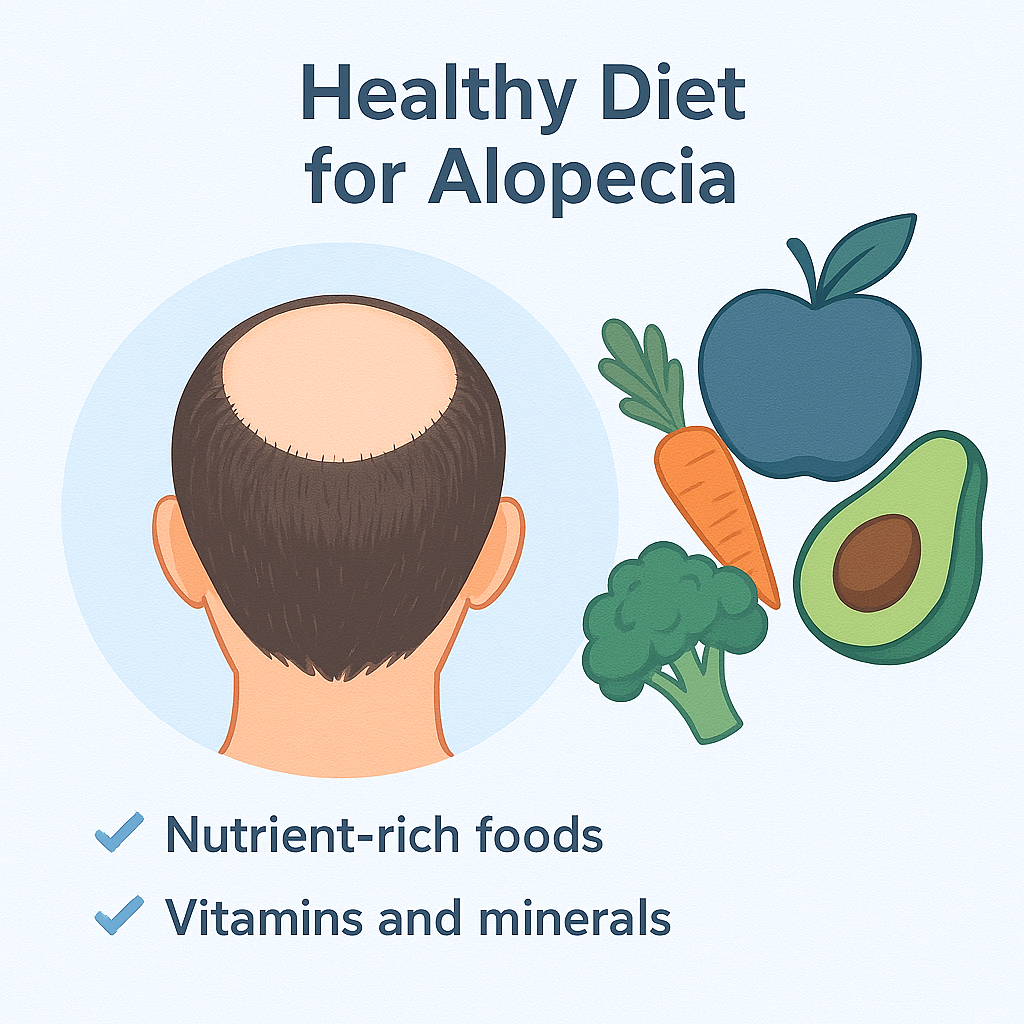
Natural & Supportive Solutions for Alopecia
| Solution | Description / Benefits | Notes / Precautions |
|---|---|---|
| Onion Juice | Contains sulfur compounds that may support keratin production and improve circulation; has anti-inflammatory effects. | May cause irritation or strong odor; patch test recommended. |
| Rosemary Oil | Known for anti-inflammatory and antioxidant properties; may support hair growth and scalp health. | Must be diluted with a carrier oil to avoid irritation. |
| Castor Oil | Rich in ricinoleic acid; may help moisturize the scalp and support follicle health. | Thick texture; should be applied in small amounts. |
| Black Seed (Kalonji) Oil | Anti-inflammatory and antimicrobial; may soothe the scalp and support hair regrowth. | Can cause reactions in sensitive individuals; patch test advised. |
| Scalp Massage | Improves blood flow to hair follicles and may help stimulate hair density over time. | Should be done gently to avoid traction or irritation. |
| Healthy Diet | Provides essential nutrients (protein, iron, zinc, vitamin D, omega-3) necessary for healthy hair growth. | Supplements should only be taken if deficiencies exist or with medical guidance. |
Home Care Post-Injection Precaution
- Avoid touching, rubbing, or scratching the injection sites for the first 24 hours.
- Do not apply oils, heavy creams, or harsh hair products immediately after the procedure.
- Use a mild, fragrance-free shampoo and begin gentle scalp washing after 24 hours.
- Keep the scalp clean without causing friction or irritation.
- Maintain a balanced diet rich in protein, zinc, iron, and vitamin D to support hair follicle health.
- Manage stress through relaxation techniques, good sleep habits, or mindfulness, as stress can worsen alopecia.
Conclusion
Steroid injections have continued to be one of the surest and effective remedies for Alopecia Areata, especially amongst those who have small and fresh bald spots. The treatment is fast, action-oriented, and the side effects of the treatment are minimal in case they are used properly. Although alopecia is an autoimmune disease that is random, there are high chances that alopecia can be successfully treated in its early stages. In the case of sudden patchy hair loss, a dermatologist will be able to initiate treatment before the disease advances in time by using a timely consultation. It is through proper guidance, consistency and supportive care that many individuals can grow strongly and healthily and once again feel good about their appearance.
FAQ’s
Q. How long does it take steroid injections to take effect?
The initial regrowth is observed in approximately four to eight weeks following the initial session by the majority of the patients.
Q. Are injections of steroids painful?
Sensations during the injections can be mildly stinging or painful, but can be expected to last only a short time and be tolerated.
Q. Are steroid injections a permanent cure for alopecia?
No. Although injections promote recovery, the alopecia can recur because it is an autoimmune disease.
Q. The frequency of injections is how often?
The majority of dermatologists prescribe one session after every four to six weeks, depending on severity.
Q. Do they have any long-term side effects?
Long-term risks are minimal when they are spaced. Excess use could lead to skin thinning or slight dents.
Q. What about the case when injections are ineffective?
Minoxidil, PRP therapy, topical immunotherapy, and systemic therapy are used as alternatives to treat the severe cases.